Use Cases
Put your menu design on a real cafe table in seconds. Upload your artwork, pick a standing card or a folded menu, and export a proof-ready image. Free, in the browser, no Photoshop and no PSD.
Loved by 2,000+ creators
Real photographs with your artwork printed onto the card. Click one to open it in the editor and drop in your design.
Nobody reads a menu flat on a white background. They see it on a table, at an angle, under warm light, with the room falling out of focus behind it. Your artwork is composited into that photograph rather than laid on top of it, so a client can judge whether the type is still readable at the size it will actually be.
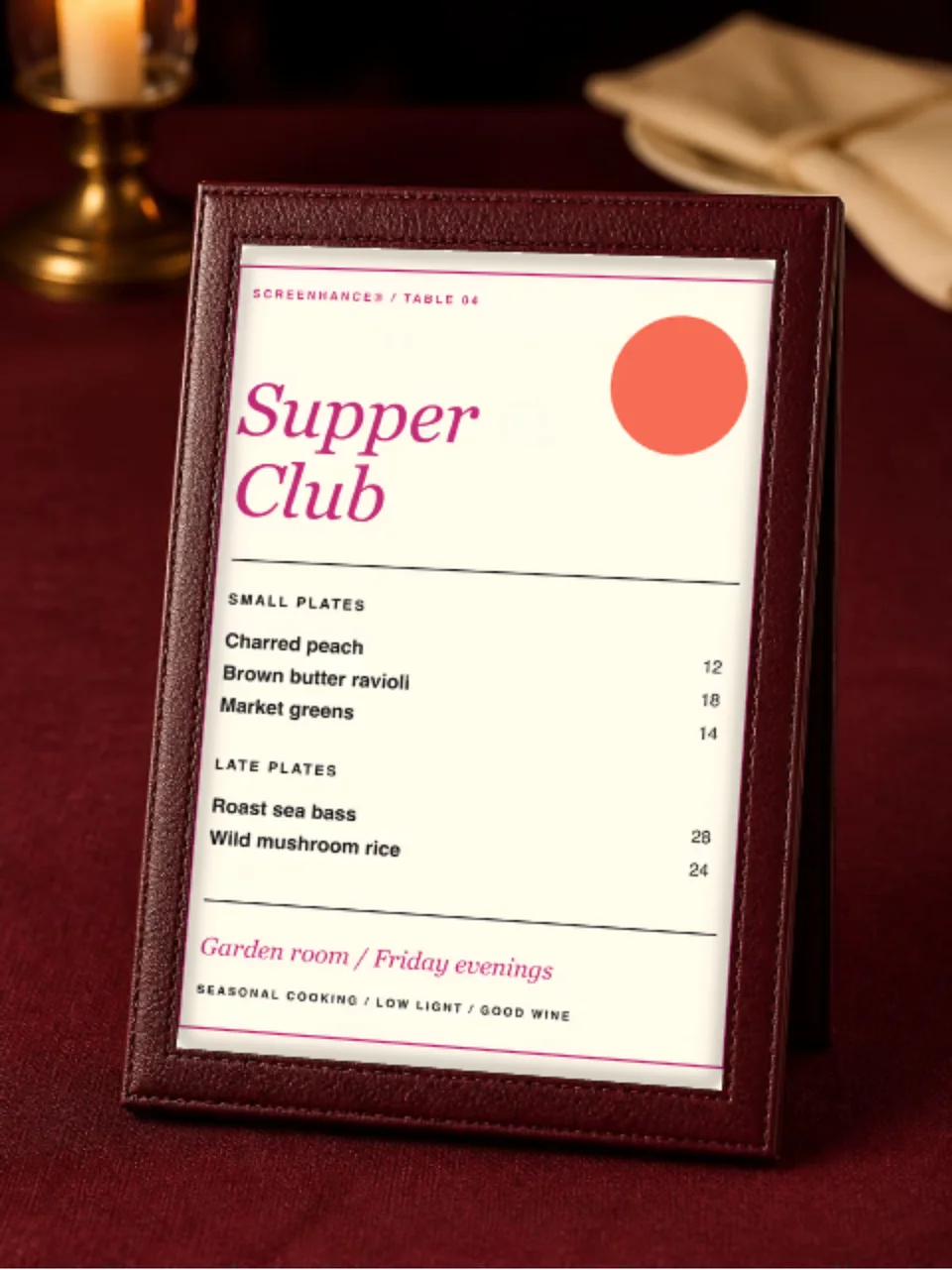
Warm light, shallow depth of field, and the shadow the card casts on the wood.
A bi-fold scene, with the fold shadow crossing your panels.
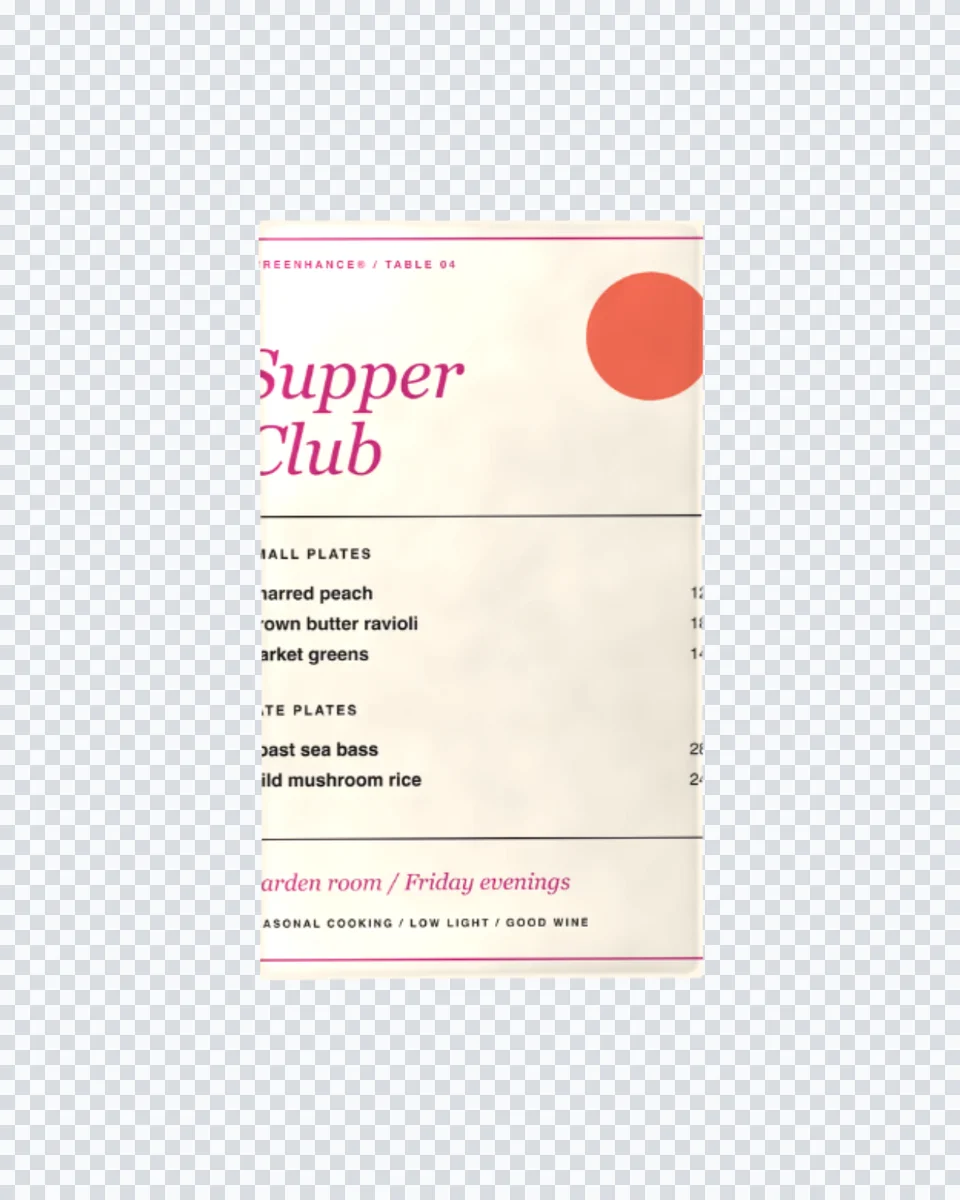
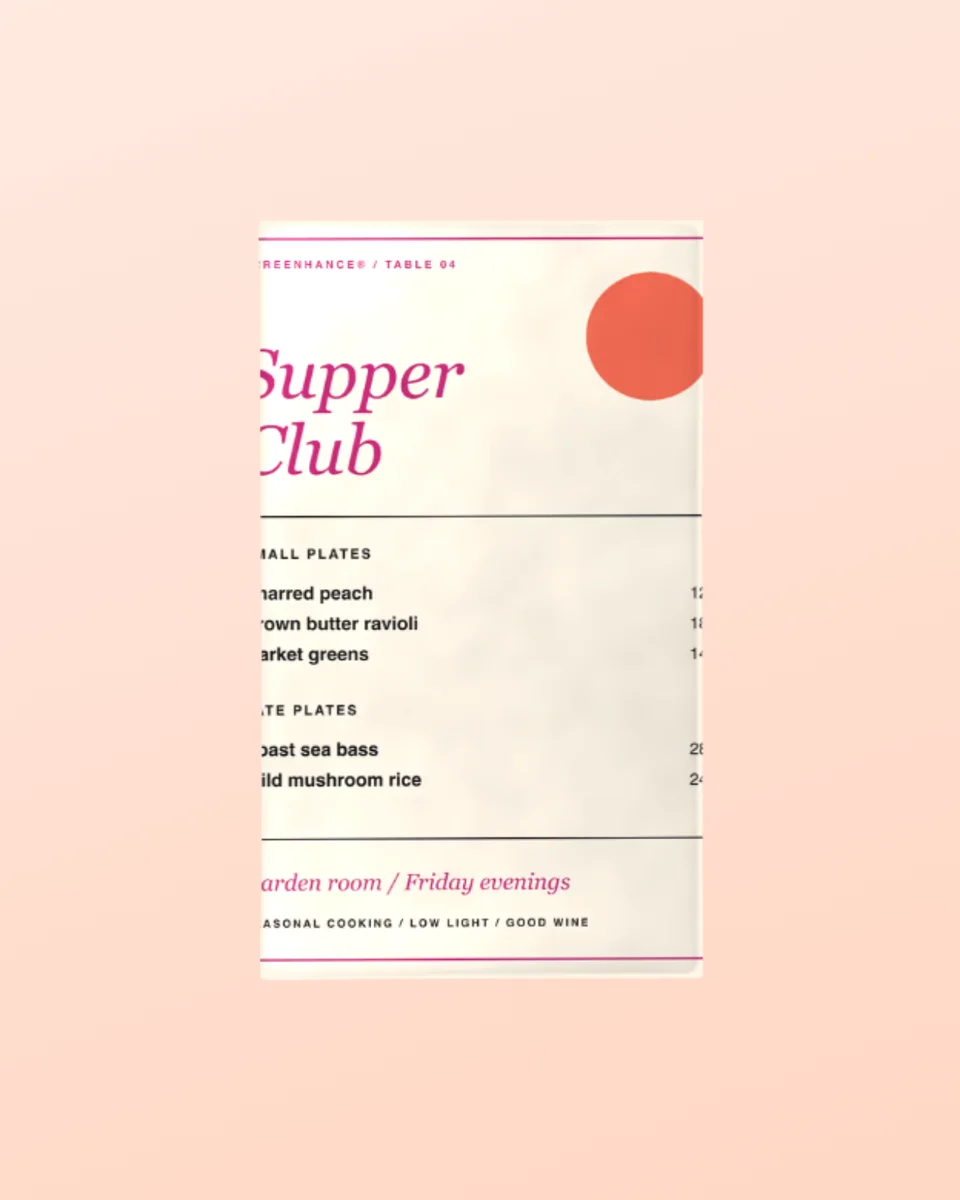
A cutout menu on transparency, for a deck slide or your own brand colour.
Create professional mockups in three simple steps. No design skills required.
Drag and drop or select any screenshot, design, or image from your device.
Pick from iPhone, iPad, MacBook, browser frames and beautiful gradient backgrounds.
Download as PNG, WebP, JPEG, GIF, or video. Ready for marketing in seconds.
Two capabilities that separate Screenhance from every other mockup tool in 2026: animated exports and App Store screenshot localization.
Template-driven motion — float, reveal, parallax. Export animated mockups at Product Hunt, landing-page, and Twitter/X dimensions. Most mockup tools are static-only.
One master design, per-locale captions, every required Apple and Google Play size per language. RTL and CJK support. Apple reports localized listings drive 2-3x install lifts.
iPhone 17 Pro Max (1320×2868), iPhone Air (1260×2736), iPad Pro M4 (2064×2752), and the full Google Play set — exported from one design in a single pass.
Pick a template, drop in your screenshot, export. No Figma, no Photoshop, no learning curve. Free tier covers 3 exports a month; the $6 Launch Pass covers a launch with 10 watermark-free image exports.
Show a seasonal menu on social without staging a photograph every time it changes.
Present a proof in context, so the conversation is about the layout and not the paper.
Pitch a whole identity with the menu, the flyer and the business card all lit the same way.
A shareable menu image before a single card has been printed.
Restaurant menus change more often than almost any other print piece. A new season, a supplier change, a price rise, and the whole thing needs re-presenting. That is exactly the workflow a PSD smart object is worst at: open Photoshop, find the layer, paste, flatten, export, and do it again in three weeks.
Screenhance composites in the browser, so re-presenting a menu is a re-upload. Your artwork is warped onto the card in the photograph, then the scene’s own light and shadow are multiplied back over it, which is why the print picks up the warmth of the table rather than sitting on it as a bright rectangle.
The most useful thing a menu mockup does is catch type that is too small. On a screen at full width, nine-point dish descriptions look fine. On a card photographed at table distance, they disappear. Because the scene composites your real artwork rather than a placeholder, the mockup fails in the same place the print would, which is the point of making one.
The rest of a hospitality set works the same way: a flyer, a folded brochure, a business card, a framed poster, or a branded mug.

Upload your menu artwork, pick a scene, and Screenhance composites it onto the card in a real photograph. The table light, the shallow depth of field and the shadow under the card all stay, so the menu looks like it is sitting in the room. Export a high-resolution PNG.
Yes. You can create and preview menu mockups for free, with a small watermark on free exports. Every scene is included on the free plan. Pro just removes the watermark, starting at a $6 one-time week pass.
Yes. A single-card menu goes into the cafe table scene. A folded menu goes into the bi-fold scene, where the fold shadow crosses your panels, which is what makes a folded menu read as folded rather than as a flat image with a line down it.
The table scene is shaped to a tall portrait card, close to A4 and A5 proportions. Design at whichever size you will print and upload the full artwork. If the file is landscape or square, the editor warns you before it crops rather than silently cutting your dish names off.
Yes, though that is a different scene. If you are presenting a QR menu or an ordering app, use a phone or tablet scene and put the screenshot on the device. The print scenes here are for a physical card on a table.
No. Menu mockups are usually distributed as PSD smart objects, which means owning Photoshop and repeating the placement for every seasonal version. Screenhance composites in the browser and shows your real artwork immediately, with nothing to install.
Explore more ways to create stunning visuals with Screenhance.
Turn any website into a framed mockup
Try it freeEdit, annotate, and reframe screenshots
Try it freeEvery launch visual from one brief: App Store, Product Hunt, OG, and website
Try it freeSee how your link's share preview renders and fix it
Try it freeOpen Graph and Twitter card images
Try it freeOptimised Twitter/X share cards
Try it freeUpload your menu, pick a scene, and export a photorealistic mockup in under a minute.